
- Home
-
Blog
How Restaurants Keep Food-Waste Odors Under Control
A practical restaurant guide to reducing food-waste odor through lid behavior, liner turnover, cleaning, ventilation, and station flow.
How to Extend Battery Life in Commercial Sensor Bins
Review practical battery-care steps, model-specific AA requirements, and how to validate Hi-na's general 4-6 month planning range in a site pilot.
From Smart Bin Prototype to ODM Production
A practical guide to moving smart bin concepts from prototype to stable ODM production through scope control, sampling, quality gates, and branding.
Smart Trash Can for Small Spaces: How to Choose the Right Size and Design
Learn how to choose a smart trash can for small spaces. Compare slim designs, sliding lids, adjustable sensor distance, easy-clean materials, and odor-management features.
Do Motion Sensor Trash Cans Need Batteries?
Learn which batteries motion sensor trash cans need, how to interpret 4–6 months of battery life, and how facilities can keep automatic lids working.
Battery Care for Motion Sensor Trash Cans
Battery Care for Motion Sensor Trash Cans
A battery complaint often begins, “We changed them three weeks ago.” Three weeks tells me when somebody opened the compartment. It says nothing about the lid. Did it sit motionless? Swing halfway and retreat? Open for every coat sleeve passing in the corridor? A facilities team can buy another packet of cells, but it would still have to answer those questions. Otherwise, next month’s packet may go into the same awkwardly placed bin.
Watch one complete opening before you move the bin
I would start with one ordinary disposal attempt, in the bin’s ordinary spot. Watch from first movement until the lid settles. Someone crossing the doorway immediately afterward provides a second observation without touching the batteries. Later, by all means test it on a bench. The bench will take away the counter overhang, though, along with any passing traffic. Write down where the first observation was made so the two tests can be compared honestly.
Reported problem
Check in the installed position
A useful result to record
No movement
Switch and battery holder
Response to one complete fresh set
Halfway stop
Bag rim, lid path, overhead space
Whether clearing the path changes it
Openings without a user
Nearby traffic
Behavior after a temporary move
Repeated battery purchases
Change dates and daily openings
How a similar bin elsewhere behaves
Only then open the holder. Its own markings tell you polarity and cell count; the drawing for a different model does not. Check that each cell meets its contact. A wet holder is a reason to stop the quick battery swap and look up the model’s service procedure. The same goes for corrosion or a broken contact. Set a leaking cell aside for handling and disposal under local rules. A new packet cannot repair the compartment beneath it.
One change, one clear result
Mixing a partly used cell with new ones makes the next service visit harder, not cheaper. For a model specified for disposable cells, use its stated type and quantity as a matched fresh set. Close the cover properly. Then try several full openings from the normal approach, with the bin back in its ordinary place. Note the result in plain language. “No movement until the cover is pressed” points toward fit or contact; “opens whenever someone passes the doorway” points elsewhere.
Hi-na Lifestyle’s AA battery installation guide handles the first setup. What exactly changed when the set went in? “Lid still catches at the rear corner” is a useful answer. “Batteries done” is not. If pressure on the compartment cover restores operation, its contacts deserve attention before a motor is ordered.
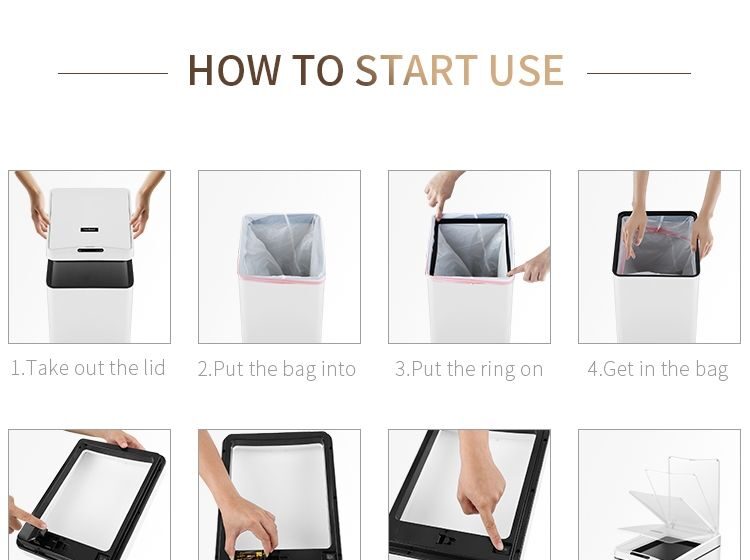
The photograph illustrates a manual-opening detail on one design when the power is exhausted. It does not tell us where the cells sit in every bin. Use the selected model’s instructions for opening and for storage. Before a stored unit goes back to work, look inside the holder again; a date on the outside of a carton cannot show what happened there.
The awkward part of a battery-life claim
“Four to six months” is easy to quote and easy to misunderstand. The missing footnote is the duty cycle: which cells, how many openings, what surroundings? In a pantry, the lid may move all morning; a meeting room down the hall may remain empty until a late afternoon call. Same cabinet, very different work for its motor. A calendar reminder made from the quoted range alone would conceal that difference.
For an order covering several sites, a small log beats a blanket timetable. A line for model, room, cell type, installation date and removal date is a start. The next line matters more: why were the cells removed? A bin that opens for passing traffic should be described that way. A bin whose lid rubs against the underside of a counter should have that noted as well. If the same model works longer across the hall, the supplier needs that comparison, including the different conditions; it is more revealing than an average for the entire shipment.
When a tender gives battery runtime real weight, the published month range needs its test conditions beside it. A sample can sit at the proposed site while someone counts lid cycles over an agreed period. Such a trial cannot predict every future room. It can tell the buyer how the quoted figure relates to this doorway, this traffic and these cells.
Better evidence for a service conversation
Consider a message that says only “slow lid, please send a new one.” What can the supplier do with it? Perhaps the bag folds into the hinge; perhaps a wall is too close; perhaps a cell has poor contact. A short clip, taken far enough back to show the bin and its surroundings, narrows the question. Attach the model, the cells fitted, their change date and one sentence about clearing the path. If the symptom vanished after a move, that belongs in the first reply, not the fourth.
Here is a hypothetical service note: “Fresh specified set fitted Tuesday. Lid still stops halfway below the shelf. It closes normally after the bin is pulled forward.” That note does not prove which part is faulty, but it makes a replacement lid a less obvious first step. If the halfway stop follows the bin into open space, I would pass the clip and service note to technical support. An invoice for batteries, on its own, cannot describe either result.
Buy cells for a model, not a product photograph
The sensor bin product range is a sensible place to compare designs. A photograph in that range cannot show what is printed inside every battery holder. I would make a small purchasing line for each chosen model: cell type, cell count, and whether a starter set comes in the carton. A warehouse order based on appearance alone is too easy to get wrong. The selected unit’s label and instructions settle the order.
The Hi-na Lifestyle company page uses the wording “Zhongshan Hi-na lifestyle Co., Ltd.” Its HN-ZT-W moving sliding sensor bin page gives a concrete battery entry: six AA alkaline cells. I would copy that entry into an HN-ZT-W order sheet, not into a generic sensor-bin column. An ODM/OEM enquiry also needs the intended site, model, quantity, packaging and corporate LOGO requirements. Put those details on the contact page enquiry and request a written answer about cells and runtime assumptions for the proposed configuration.
Conclusion
I would put one sentence at the end of every battery-change record: “After the new set, the lid ____.” That blank forces a result onto the page. Fill it only after watching a few cycles with the bin back in position. If the same complaint returns, the next technician has a starting point more useful than the date of a battery purchase.
FAQs
1. What if only one cell appears weak?
Follow the model instructions. In a multi-cell holder, a complete matched fresh set gives a much clearer fault check than a mix of old and new cells.
2. The lid is slow even with new batteries. What next?
Watch where it slows. A caught bag or restricted space can affect its travel. Check the holder as well, then describe the result after clearing the path.
3. Which details belong on the maintenance record?
At minimum: model, location, specified cell type, change date and what the lid did during several full cycles. Add repeated openings or an obstruction if either was seen.
sensor dustbins’ factory
Welcome all customer to
Welcome all customer to
visit our company every time!
Please fill out the form below and we will get back to you as soon as possible.